
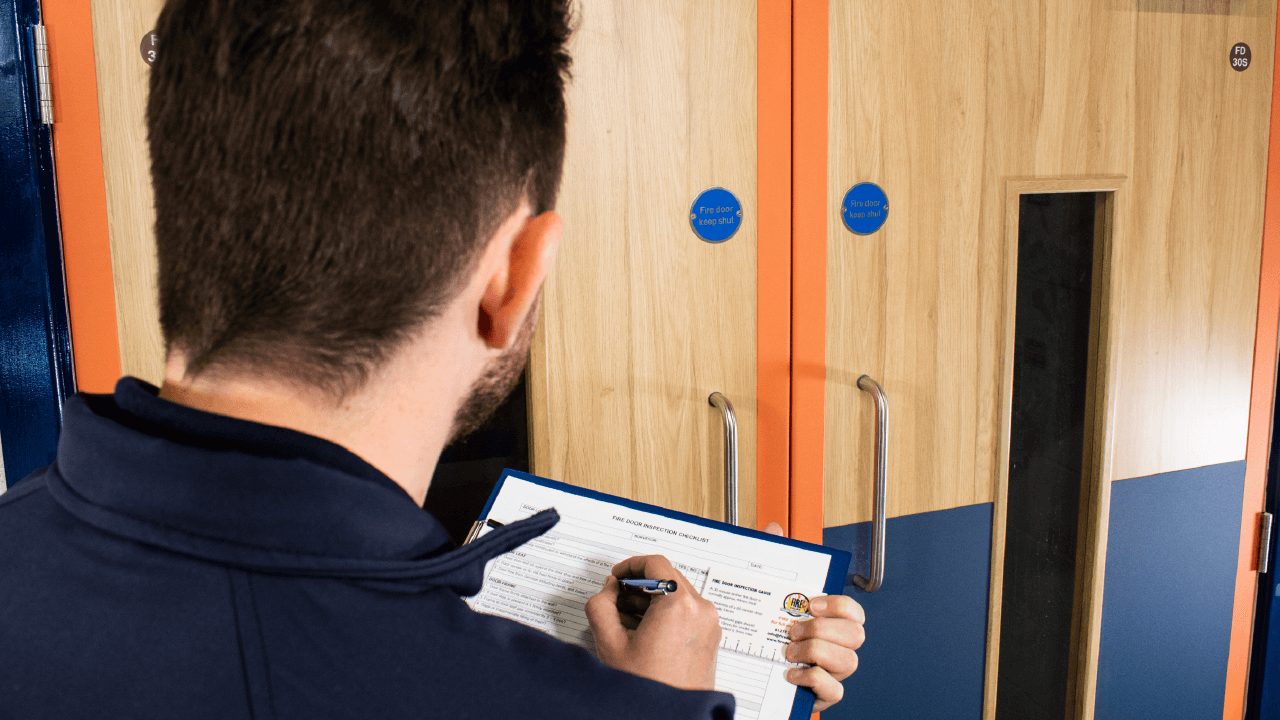
Fire doors help contain fire and smoke when the whole assembly is suitable, correctly installed and maintained. Damage, excessive gaps or a faulty closer can undermine performance. This checklist explains routine checks and when to obtain specialist advice. The specific statutory check intervals below apply to defined residential buildings in England; other premises need an appropriate maintenance regime.
Why fire door inspection matters
A fire door is an assembly of leaf, frame, seals and hardware. Labels such as FD30 and FD60 refer to fire-resistance performance under specified test conditions, commonly 30 and 60 minutes. They do not guarantee that an occupant can safely remain beside a door for that time in a real fire. Suitability depends on the assembly, installation and building’s strategy.
Crucially, a fire door only performs to its rating if every part of the assembly is intact and correctly installed. Inspection exists to confirm that nothing has been damaged, removed, painted over, propped open or modified in a way that compromises performance.
The legal requirements
Under the Regulatory Reform (Fire Safety) Order 2005, the responsible person for a building must ensure fire doors are maintained in efficient working order and good repair. The Fire Safety (England) Regulations 2022 placed additional, specific duties on those responsible for the common parts of multi-occupied residential buildings, requiring regular checks of fire doors.
Responsibility for inspection sits with the responsible person — typically the employer, building owner or managing agent. This duty cannot simply be delegated away: even where a competent contractor carries out the checks, the responsible person remains accountable for ensuring they happen and that defects are put right. Failure to comply can lead to enforcement action, fines and, in serious cases, imprisonment.
How often should fire doors be inspected?
Set checks according to the premises, usage, risk assessment and applicable law. Distinguish routine functional checks from a technical assessment of whether a door is suitable for its location. Government fire-door guidance explains the additional duties for residential buildings in England.
- Routine observation: identify wedging, damage, obstructions and failure to close; check more often where usage or risk warrants it.
- Scheduled checks: follow the legal intervals where applicable and the building’s risk-based maintenance programme.
- Technical assessment: obtain competent advice on suitability, alterations or defects; routine checks alone do not certify a doorset.
For English residential buildings with two or more domestic premises, common parts and a top storey more than 11 metres above ground level, communal fire-door checks are required at least every three months and best endeavours must be used to check flat entrance doors at least every 12 months. Other buildings remain subject to suitable maintenance duties; the table distinguishes these requirements.
| Door / building scope | Check requirement |
|---|---|
| Communal fire doors: qualifying English residential buildings with top storey over 11 m | At least every 3 months |
| Flat entrance doors: the same qualifying buildings | Best endeavours to check at least every 12 months |
| Other premises and buildings below that threshold | Risk-based maintenance and checks; no universal annual interval under these regulations |
Door leaf and frame
Start with the structure of the door itself and the frame it hangs in. Look for anything that affects how the door sits and seals:
- Check the leaf for surface damage, holes or signs of impact and wear.
- Look for frame distortion or loose fixings, and check the wall around the frame is sound.
- Confirm the door sits properly within the frame without binding or sticking.
- Check frame fixings are secure — screws and brackets tight.
- On timber doors, look for rot or moisture damage; on steel doors, check for rust or corrosion.
- Check the fit against the doorset’s specification; seek competent advice if alignment or distortion affects closing or sealing.
Intumescent strips and smoke seals
Intumescent strips expand with heat, while smoke seals limit leakage at ordinary temperatures. Check fitted seals for damage and correct contact. Some existing flat entrance doors may be acceptable without modern seals, depending on the risk assessment; their absence is not automatically proof that a door must be replaced.
- Check strip continuity — there should be no missing sections.
- Confirm proper adhesion to the door or frame and correct positioning at the door edges.
- Look for paint build-up covering the strips, or strips that have been painted over repeatedly.
- Check smoke seals compress properly when the door closes and are undamaged and intact.
Door gaps and clearances
Excessive or unsuitable gaps can reduce a door’s performance. Check clearances against the doorset’s specification and seek competent advice where measurements or requirements are uncertain.
- Head and side gaps should meet the doorset specification; government guidance for routine flat-door checks identifies 4 mm as the usual upper limit.
- The threshold gap depends on the door and smoke-control specification; do not assume that a generic 3–8 mm range is acceptable.
- Check head, sides and threshold against their respective requirements; the bottom gap need not match the other edges.
- The self-closing mechanism must pull the door fully closed against the stops from any open position.
Door closers and hinges
A fire door must operate as required by the building’s fire strategy. Where a self-closing device or latch is required, check that it works and that the door closes fully into its frame; some doors are instead intended to be kept locked shut. Report defects and seek competent advice if the intended arrangement is unclear.
Closers:
- Check the closer is securely mounted with all fixings tight and operates smoothly without sticking or jerking.
- Confirm the closing speed is correctly adjusted and the door latches fully into the strike plate.
- Look for oil leaks from hydraulic closers.
- Where a self-closer is required, check full closing from different openings. The government’s simple check uses a fully open door and an opening of around 15 degrees, overcoming any latch or floor resistance.
Hinges:
- Check that hinge type, number and fixings match the doorset’s specification; do not apply a universal three- or four-hinge rule.
- Check all hinge screws are present, of the correct length, and none are missing, loose or damaged.
- Inspect hinge pins for wear or displacement and confirm the hinges operate smoothly without binding.
- Where intumescent pads are fitted behind hinges, check they remain intact and undamaged.
Locks, latches and glazing
Hardware must be compatible with the doorset and its fire-resistance evidence. A component label alone does not prove that the assembled door is suitable. Refer repairs or modifications to a person competent for that work.
- Check locks, latches and handles are compatible with the doorset, securely fixed and usable as required by the escape arrangements.
- Confirm latches engage fully and align correctly with the strike plate, and that the strike plate is secure and free of excessive wear.
- Where fitted, check letterboxes for damage or alterations and confirm their suitability for the door through the available evidence or competent advice.
- Check glazing and its securing system for damage and suitability; investigate unclear evidence with competent assistance.
Signage and certification
Check the available identification, specification and installation records. For existing flat entrance doors, government guidance makes clear that missing certification alone does not prove a door is unfit for purpose; suitability is addressed through the fire risk assessment.
- Where labels or plugs are fitted, record their details and condition without damaging the door.
- Use available records to confirm the required performance and compatible components; obtain competent advice where evidence is unclear.
- Provide signs appropriate to the door’s function and applicable guidance. Do not apply a blanket requirement for identical signs on both sides of every flat entrance or other fire door.
Common issues to watch for
Across inspections, the same problems come up again and again. Be especially alert to:
- Doors propped or wedged open, defeating their purpose entirely.
- Edge or bottom gaps that exceed tolerance.
- Missing, damaged or painted-over intumescent strips and smoke seals.
- Faulty closers that fail to shut and latch the door fully.
- Missing or damaged hinge screws, and worn or loose hinges.
Documentation and record-keeping
Record checks so defects, access attempts and remedial work can be followed up. Records provide evidence of the work done, but do not replace putting defects right. Each inspection report should capture:
- The date, checker’s name and role, and the scope of the check or technical inspection.
- The location and reference of each door inspected.
- The condition and functional findings for each door, with any uncertainty requiring technical assessment.
- Any defects identified and a remedial action plan with responsibilities and timescales.
Keep records of checks, defects, repairs and follow-up, including attempts to obtain access for flat entrance-door checks. Use a retention policy appropriate to the building and applicable obligations; these regulations do not prescribe a blanket five-year retention period for every door inspection record.
Build fire safety awareness alongside the competent inspections and maintenance your premises require.
Explore the Fire Warden / Fire Marshal Course →Sources & references
- Regulatory Reform (Fire Safety) Order 2005 — current legislation
- GOV.UK — Regulation 10: scope and check intervals
- London Fire Brigade — Fire doors
- GOV.UK — Fire-door checking guidance
- GOV.UK — Fire-door checklist
- GOV.UK — Fire safety recording duties
- Fire Safety (England) Regulations 2022 — legislation

Mark writes about workplace fire safety, compliance and online training for Fire Marshal Training, part of Online CPD Academy.