
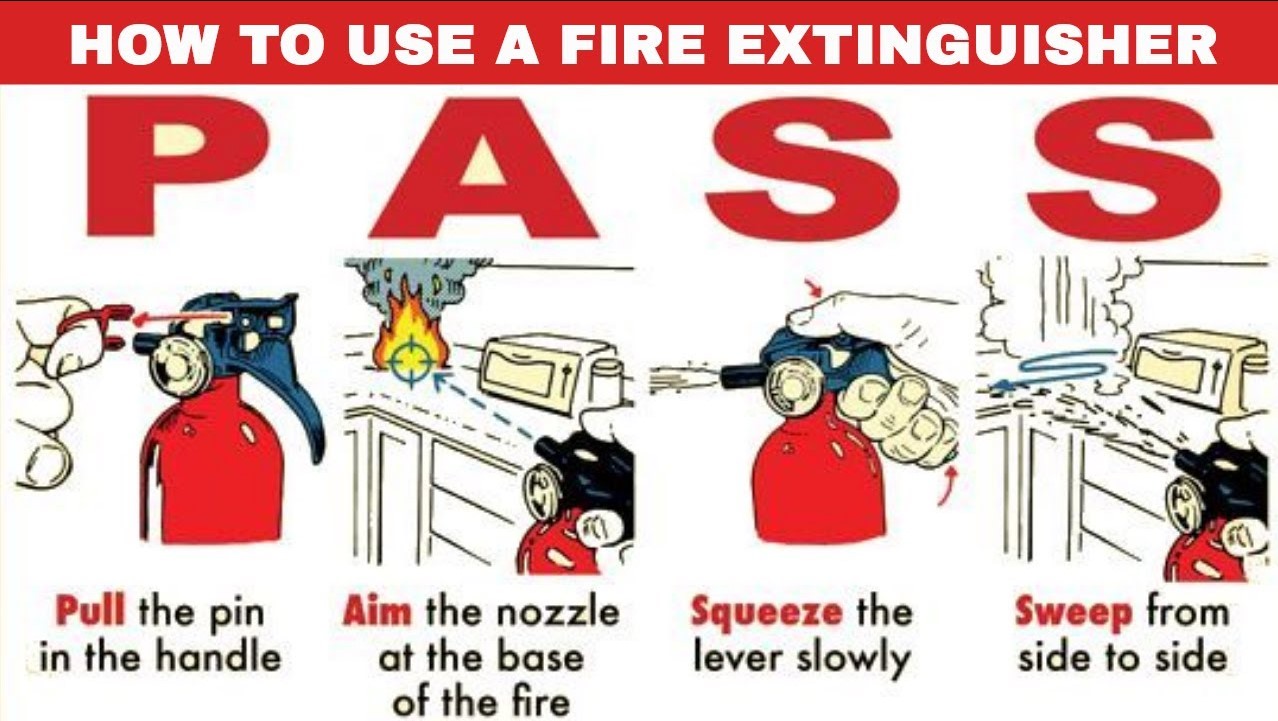
PASS stands for Pull, Aim, Squeeze and Sweep, a reminder for operating many portable fire extinguishers. It is useful during training, but does not replace the product's instructions or make it safe to tackle every fire. This guide explains the steps, the decision to evacuate, and the separate meaning of PASS in professional firefighting.
What does PASS stand for?
The US Fire Administration describes the PASS reminder as four steps. The operating mnemonic is widely used, but UK fire classes and extinguisher labels differ from US classifications:
- P — Pull the safety pin
- A — Aim at the base of the fire
- S — Squeeze the handle
- S — Sweep from side to side
Read the label and learn the equipment before an emergency. Some agents, particularly foam and wet chemical, require a different application technique. The illustration and acronym are reminders, not complete instructions for every extinguisher or fuel.
The four steps explained
These steps describe a common portable-extinguisher arrangement. Use only equipment you have been trained to operate, following its instructions and the premises' emergency plan.
P — Pull
Remove the safety pin or release the safety device as directed by the manufacturer. Keep the discharge outlet pointed safely and avoid squeezing the operating handle while releasing the pin. Different models can have different controls.
A — Aim
For many suitable solid-material fires, aim low at the burning fuel. The correct application and distance depend on the agent, model and fire. Follow the label and training; there is no universal six-to-eight-foot rule. Do not direct a jet into burning cooking oil.
S — Squeeze
Operate the handle as instructed, controlling the discharge. The appropriate method depends on the unit; there is no general rule that continuous discharge is always better than bursts. Extinguishers have limited contents, so withdraw if the attempt is not controlling the fire.
S — Sweep
Where the instructions call for it, sweep across the burning area from a safe position. Keep your escape route available. Do not advance into smoke or stay to attack repeated hot spots; leave if conditions worsen, the fire is not controlled immediately or the extinguisher runs out.
| Letter | Action | How to do it |
|---|---|---|
| P | Pull | Pull the safety pin to unlock the extinguisher. |
| A | Aim | Aim as instructed for the agent, fuel and operating distance. |
| S | Squeeze | Operate the handle according to the product instructions. |
| S | Sweep | Sweep where instructed; withdraw if the fire is not controlled. |
When is it safe to tackle a fire?
An extinguisher may be appropriate only for a small fire in its earliest stage. Fire-service advice makes clear that escape takes priority. Before any attempt, all of the following need to be satisfied:
- The alarm has been raised, people are leaving danger and 999 has been called.
- The fire is small and contained, there is no smoke exposure, and a clear escape route remains behind you.
- You have suitable equipment for the fuel and surroundings and understand its label and limitations.
- You are trained for the attempt and it is consistent with the premises' emergency plan.
If any condition is not met, leave and let firefighters deal with it. Do not tackle a spreading fire, a smoke-filled room or a failing lithium-ion battery. At home, do not attempt to fight a pan fire. Raise the alarm, evacuate and call 999 from a safe place.
The emergency call should already have been made before an attempt. If visible flames stop, tell firefighters what happened and do not assume the equipment or area is safe. Do not re-enter to inspect or collect belongings.
Using the right extinguisher
PASS cannot make the wrong extinguisher suitable. Standard water is dangerous on live electrical equipment or burning cooking oil. Read the complete rating and operating instructions, not just the colour. Our extinguisher guide explains the common UK types and their limitations.
The other meaning of PASS
In professional firefighting, PASS can mean Personal Alert Safety System. NIST describes these devices as equipment that gives an audible signal when a firefighter needs help, including automatic activation when the wearer remains motionless. This is distinct from the extinguisher mnemonic.
Why PASS matters in the workplace
The Fire Safety Order in England and Wales requires adequate employee safety training appropriate to the risks and duties. It does not prescribe PASS as a named test of competence. Staff need the site's alarm, escape and emergency arrangements; anyone expected to use an extinguisher also needs suitable equipment-specific training and clear limits on when to withdraw.
Use online learning to support extinguisher awareness, alongside site procedures and equipment-specific practical training.
Explore the Fire Warden / Fire Marshal Course →Sources & references
- US Fire Administration: PASS operating reminder (UK fire classes differ)
- Scottish Fire and Rescue Service — Business guidance and extinguisher safety
- London Fire Brigade — What to do if a pan catches fire
- NIST — Electronic safety equipment and Personal Alert Safety Systems
- Regulatory Reform (Fire Safety) Order 2005 — current legislation

Mark writes about workplace fire safety, compliance and online training for Fire Marshal Training, part of Online CPD Academy.