
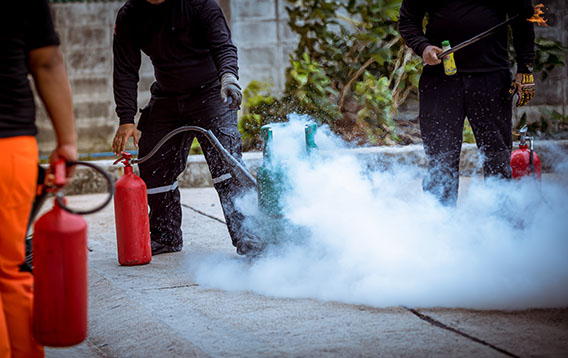
The number of fire marshals depends on the duties that must be carried out, the building, its occupants and who is present on each shift. The Fire Safety Order in England and Wales requires sufficient competent people for the emergency arrangements; it does not prescribe marshal-to-employee ratios. Use the fire risk assessment and a practical staffing plan to establish coverage, including absences.
This guide explains how to identify the tasks, areas and shifts that need cover, decide who can carry them out and test whether the arrangements work. Scotland and Northern Ireland have separate fire safety regimes, so check the law and guidance applying to the premises.
Quick answer: match people to the plan
There is no official universal ratio that makes every workplace compliant. Define the tasks in the emergency plan and ensure enough trained people will actually be present to perform them. Consider:
- Required tasks — alarm, evacuation assistance, reporting and any other roles identified by the plan.
- Building coverage — occupied areas, separate zones, floors and escape arrangements.
- Occupants’ needs — visitors, public access and anyone requiring assistance.
- Actual availability — enough trained people present whenever the premises are occupied.
- Absence cover — planned deputies or other reliable arrangements for leave and sickness.
- Test the plan — use drills and reviews to identify gaps in coverage.
Understanding the role of a fire marshal
Fire marshals support the premises’ fire safety arrangements through assigned checks, reporting hazards and helping maintain records. During an emergency they follow the site plan, guide people towards safe exits and assist with accounting for occupants. Report missing people, their last known locations and any unchecked areas; a headcount alone cannot establish that the building is clear.
The terms fire marshal and fire warden are commonly used for the same workplace role. Organisations may allocate different responsibilities or appoint a coordinator, but those titles do not establish a universal legal hierarchy or a higher training qualification. Define the actual duties, competence and authority in the premises’ arrangements.
The legal duty to appoint enough marshals
The Regulatory Reform (Fire Safety) Order 2005 is the primary legal framework for fire safety in non-domestic premises in England and Wales. It requires the responsible person to carry out a fire risk assessment and to appoint a sufficient number of competent persons to implement fire safety measures and assist with evacuation.
The Order does not specify marshal-to-staff ratios or require a particular job title. Nominate enough competent people to implement the emergency procedures, with arrangements appropriate to the premises and occupants. A suitable assessment and practical plan should show how the necessary roles will be covered.
Check any specific conditions in the insurance policy and contracts alongside the fire risk assessment. Do not assume an insurer requires a particular national ratio; requirements depend on the policy, and insurance conditions do not replace the legal duty to provide sufficient cover.
Workplace factors that change the number
The staffing decision should consider the work to be done and the people available to do it. Relevant factors include:
- Fire risk level. Consider hazards such as flammable materials, machinery and hot processes, the precautions in place and the emergency tasks they create. Match competent staffing to those tasks rather than assuming a fixed number for an industry.
- Building size and layout. Assess how floors, separate areas, corridors and escape routes affect communication and the duties people can safely carry out. Confirm that nominated staff can cover the planned roles without delaying their own escape.
- Occupancy and visitors. Consider the number of people, their familiarity with the premises and any assistance they need. Review cover for peak periods or events where these change the emergency arrangements.
- Shift patterns. Ensure the necessary emergency roles can be carried out during each occupied shift, including nights, lone working and handovers. Base cover on actual attendance and tasks, not a fixed proportion of employees.
- People needing assistance. Account for the staff, time, equipment and absence cover needed to implement personal or assisted-evacuation arrangements.
Assessing coverage for different premises
The table shows considerations for different settings. The examples are not fixed risk classifications or numerical staffing rules; confirm the arrangements through a suitable assessment and emergency plan.
| Setting | Typical considerations | How to decide cover |
|---|---|---|
| Simple premises | Clear layout, occupancy and routine absence | Ensure each necessary role can be performed by people present |
| Multiple areas or shifts | Separate zones, public access and working patterns | Plan coverage by area and shift, with deputies where needed |
| Complex or assisted evacuation | Occupants’ needs, phased strategies and specialist hazards | Match competent staffing to the assessed strategy and practise it |
Record the responsibilities and minimum operational cover needed for your own premises, together with how absences will be covered. A fixed minimum of two, one person per floor or a ratio based only on employees may be too much for one situation and inadequate for another. The test is whether the required arrangements can be carried out safely whenever people are present.
Covering shifts, holidays and absence
A ratio that works on paper fails the moment your only marshal is on annual leave. Continuous cover is a core part of compliance, so plan for the days when marshals are unavailable.
Use rosters and planned deputies to maintain the cover identified by the assessment. Check holidays, sickness, meetings, remote work and shift changes rather than automatically doubling a headcount. Review actual attendance and use drills to confirm that roles can be performed when nominated people are absent.
Appointing and training your marshals
Choose people with the competence, training and availability to perform the assigned role safely. Explain their responsibilities and provide the authority, information and support they need. Consider coverage across departments and shifts, including deputies; any physical assistance must be planned around the needs and capabilities of the people involved.
Under the Fire Safety Order, competent persons must receive appropriate training. Core elements include fire risk assessment principles, evacuation procedures and routes, use of fire safety equipment, and clear communication during emergencies. Marshals should also know how to run an effective fire drill and understand the different extinguisher types and their uses. Regular refresher training keeps skills current and reflects any changes to the workplace.
Ongoing duties: drills, equipment and prevention
Appointing competent people needs to be supported by practice. Government workplace guidance recommends at least one drill per year and recording the results. Choose more frequent practice where the assessment calls for it, and include different shifts. Use the results to improve routes, communication and coverage.
Marshals can carry out assigned visual checks and report faults, while competent people undertake testing, servicing and repairs at intervals appropriate to each system. Do not assume all equipment has the same annual servicing schedule: fire alarms, emergency lighting, extinguishers and fire doors have different requirements.
Vulnerable occupants and special considerations
Where people need help to evacuate, agree appropriate assistance arrangements with them. Identify trained helpers, absence cover, routes, communication and any equipment specified by the plan. Evacuation chairs are one possible aid, not a universal requirement. Refuges need arrangements for onward escape, and helpers should practise the agreed procedures.
During an evacuation, follow the site plan, guide people towards a safe exit and pass clear information to the coordinator and emergency services. Any area check must be safe, undertaken while leaving and must not delay escape. Never enter smoke or re-enter to search; report unchecked areas and anyone unaccounted for.
Train the right number of competent fire marshals for your workplace.
Explore the Fire Warden / Fire Marshal Course →Sources & references
- Regulatory Reform (Fire Safety) Order 2005 — current legislation
- GOV.UK — Sufficient competent people and emergency procedures
- GOV.UK — Workplace fire safety equipment, drills and training

Mark writes about workplace fire safety, compliance and online training for Fire Marshal Training, part of Online CPD Academy.