
Fire safety combines legal duties with practical precautions. The Fire Safety Order is the principal framework for most non-domestic premises in England and Wales; Scotland and Northern Ireland have separate legislation. This guide explains the England and Wales duties, current recording requirements and additional residential rules that apply specifically in England.
Understanding fire safety rules and legislation
Fire safety law in England and Wales is built on the Regulatory Reform (Fire Safety) Order 2005 — usually shortened to the Fire Safety Order or the FSO. It applies to virtually all non-domestic premises, including workplaces, shops, offices, factories, care homes and the common parts of blocks of flats. The Order replaced a patchwork of earlier laws with a single, risk-based duty: identify the fire risks in your premises and take reasonable steps to manage them.
The Fire Safety Act 2021 clarified that the Order covers structure, external walls and flat entrance doors in multi-occupied residential buildings. The Fire Safety (England) Regulations 2022 added duties at different building-height thresholds. Section 156 of the Building Safety Act 2022 also strengthened recording and cooperation duties across Fire Safety Order premises from 1 October 2023. In England, Residential PEEP regulations have applied to specified residential buildings since 6 April 2026.
For most employers and building managers, the practical message is straightforward: fire safety is a legal duty, it is based on assessing and reducing risk, and it must be kept up to date as buildings and their use change.
The role of the responsible person
In an employer-controlled workplace, the employer is the responsible person. Owners, occupiers or others may be responsible persons in other circumstances. Other people with relevant control can also have duties, limited to that control; all relevant dutyholders must cooperate and coordinate.
The responsible person must make sure a fire risk assessment is carried out, put in place appropriate general fire precautions, provide staff with information and training, and keep everything under review. In practice, much of this work is delegated to competent people, including trained fire wardens, but the legal accountability remains with the responsible person.
Conducting fire risk assessments
The fire risk assessment identifies hazards, people at risk and necessary precautions. All responsible persons under the Fire Safety Order must record the full assessment and fire safety arrangements, regardless of employee numbers, and keep the assessment under regular review.
The five steps of a fire risk assessment
Government guidance sets out a five-step approach that works for most premises:
- Identify the fire hazards — sources of ignition, fuel and oxygen.
- Identify the people at risk — staff, visitors, and anyone especially vulnerable.
- Evaluate, remove or reduce the risks — and protect against those that remain.
- Record your findings, prepare an emergency plan and provide training.
- Review and update the assessment regularly.
Identifying hazards and people at risk
Common sources of ignition include heaters, faulty or overloaded electrics, cooking equipment, hot work and smoking materials. Common fuels include paper, packaging, waste, flammable liquids and furnishings. When assessing who is at risk, pay particular attention to people who may need extra help to escape — for example those with mobility, sensory or cognitive impairments, lone workers, and members of the public unfamiliar with the layout.
Recording, planning and reviewing
Since 1 October 2023, the Fire Safety Order requires every responsible person to record the assessment in full, including all findings, and the fire safety arrangements. Government guidance explains the revised duties. Review regularly and whenever the assessment may no longer be valid or a significant relevant change occurs; the Order does not set a universal annual expiry.
Key fire safety equipment and systems
General fire precautions include the equipment and systems that detect a fire, raise the alarm, help people fight a small fire and contain the spread. The right provision depends on the risk assessment, but several elements are common to most premises.
Fire detection and alarm systems
Premises need an appropriate means of detecting a fire and warning everyone inside. This may range from a simple manually operated system in small, low-risk premises to an automatic fire detection and alarm system in larger or higher-risk buildings. Whatever the system, it must be capable of alerting everyone in time to escape safely.
Fire extinguishers: types and usage
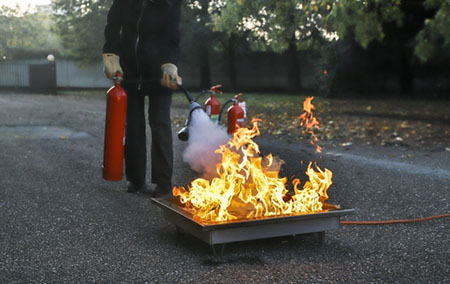
Portable fire extinguishers allow trained staff to tackle a small fire in its early stages. Using the wrong type can be ineffective or dangerous, so the correct extinguisher types must be provided for the risks present.
| Extinguisher type | Suitable for | Identifying colour |
|---|---|---|
| Water | Class A — wood, paper, textiles | Red |
| Foam | Class A and Class B (flammable liquids) | Cream |
| CO₂ | Electrical equipment and Class B | Black |
| ABC dry powder | Classes A, B and C as labelled; assess suitability and occupied-space limitations | Blue |
| Wet chemical | Class F — cooking oils and fats | Yellow |
Emergency lighting and fire doors
Emergency lighting supports escape when normal lighting fails. Fire doors help limit the spread of fire and smoke when suitably specified, installed and maintained. Keep them closed or use an appropriate hold-open arrangement that releases so they close when required. An ordinary door closer does not authorise wedging a door open.
Escape routes and evacuation procedures
If a fire does break out, the priority is getting everyone out quickly and safely. The risk assessment must establish suitable means of escape and the procedures people will follow.
Designing and maintaining escape routes
Escape routes should lead to a place of safety, have adequate capacity for the occupants and be suitably signed and lit. Escape doors must be readily usable in an emergency; any controlled locking needs to suit the assessed arrangements. Keep routes and exits free from obstructions such as stock, furniture, deliveries and waste.
Fire drills and staff training
Provide staff with suitable information and training and nominate enough competent people to implement the emergency procedures. Wardens may guide evacuation and make safe checks while leaving, but must not enter smoke, re-enter or delay escape to search. Government workplace guidance recommends at least one recorded drill annually; the assessment may require more frequent practice.
Fire safety duties and responsibilities
The responsible person carries the principal legal duties, but fire safety is genuinely a shared effort across a building.
Maintenance of fire safety systems
Maintenance must suit the system and premises. The following are common intervals in government workplace guidance, not a substitute for the risk assessment, applicable standards, manufacturer’s instructions or specific statutory duties:
- Fire alarm systems — tested weekly, with periodic servicing by a competent engineer.
- Emergency lighting — brief function tests monthly and a full duration test annually.
- Fire extinguishers — visually checked regularly and serviced annually.
- Fire doors — risk-based checks and maintenance; in qualifying English residential buildings with top storey over 11 m, communal checks at least every 3 months and best endeavours for flat entrance checks at least every 12 months.
Record-keeping, cooperation and coordination
Keep records of the assessment, emergency plan, tests, maintenance, training and action taken. These support effective management and provide evidence of the work done. Where premises are shared, responsible persons must cooperate, coordinate precautions and share relevant information.
Ensuring ongoing compliance
Fire safety is not a one-off task. Buildings, occupants and activities change, and the precautions must keep pace.
Regular reviews and competent support
Review the fire risk assessment periodically and whenever something significant changes — a refurbishment, a change of use, new equipment or a different pattern of occupancy. Third-party certification can help when selecting an assessor or service provider, but check the scheme's scope, the person's relevant experience and whether they are suitable for your premises.
Changes in building use or occupancy
A change that seems minor can have a real effect on fire safety — converting storage into office space, increasing the number of people on site, introducing new processes or installing new partitions can all alter escape times, fire loading and risk. Whenever the use or occupancy of a building changes, revisit the assessment and update the precautions accordingly.
Key takeaways
- Fire safety combines the legal duties that apply to the premises with practical measures to prevent fires and protect people.
- The Fire Safety Order is the principal framework for most non-domestic premises in England and Wales; Scotland and Northern Ireland have separate legislation.
- The responsible person must ensure a fire risk assessment is carried out, suitable precautions are in place, staff are trained and everything is kept under review.
- Recording duties apply to all Fire Safety Order responsible persons, while additional residential requirements have defined geographic and building scopes.
Make sure your workplace has trained fire wardens in place.
Explore the Fire Warden / Fire Marshal Course →Sources & references
- Regulatory Reform (Fire Safety) Order 2005 — current legislation
- GOV.UK — Fire Safety (England) Regulations 2022
- GOV.UK — Recording duties from 1 October 2023
- GOV.UK — Residential PEEPs regulations and duties
- GOV.UK — Guide for people with fire safety duties
- GOV.UK — Fire risk assessment checklist
- GOV.UK — Workplace fire safety equipment, drills and training

Mark writes about workplace fire safety, compliance and online training for Fire Marshal Training, part of Online CPD Academy.